Chromatin States and TF Modules
There are a few existing ENCODE genome characterization annotation using ENCODE ChIP-seq data. In this study, the annotation we integrates consisted of types of annotation. One type of the annotation mainly focused on histone modifications, while the other used the co-localization information of transcription factors.
Chromatin states
The two main chromatin state mapping that we used for FCC comparisons were cCREs and ChromHMM.
ENCODE candidate cis-regulatory elements (cCREs)
After intersecting multiple genomic information (histone modifications, CTCF cCREs applied a series of if-else statements to classify regions into different chromatin states.
ENCODE ChromHMM chromatin states
ChromHMM is a multivariate hidden Markov model trained on histone modifications to identify chromatin states.
TF co-association modules
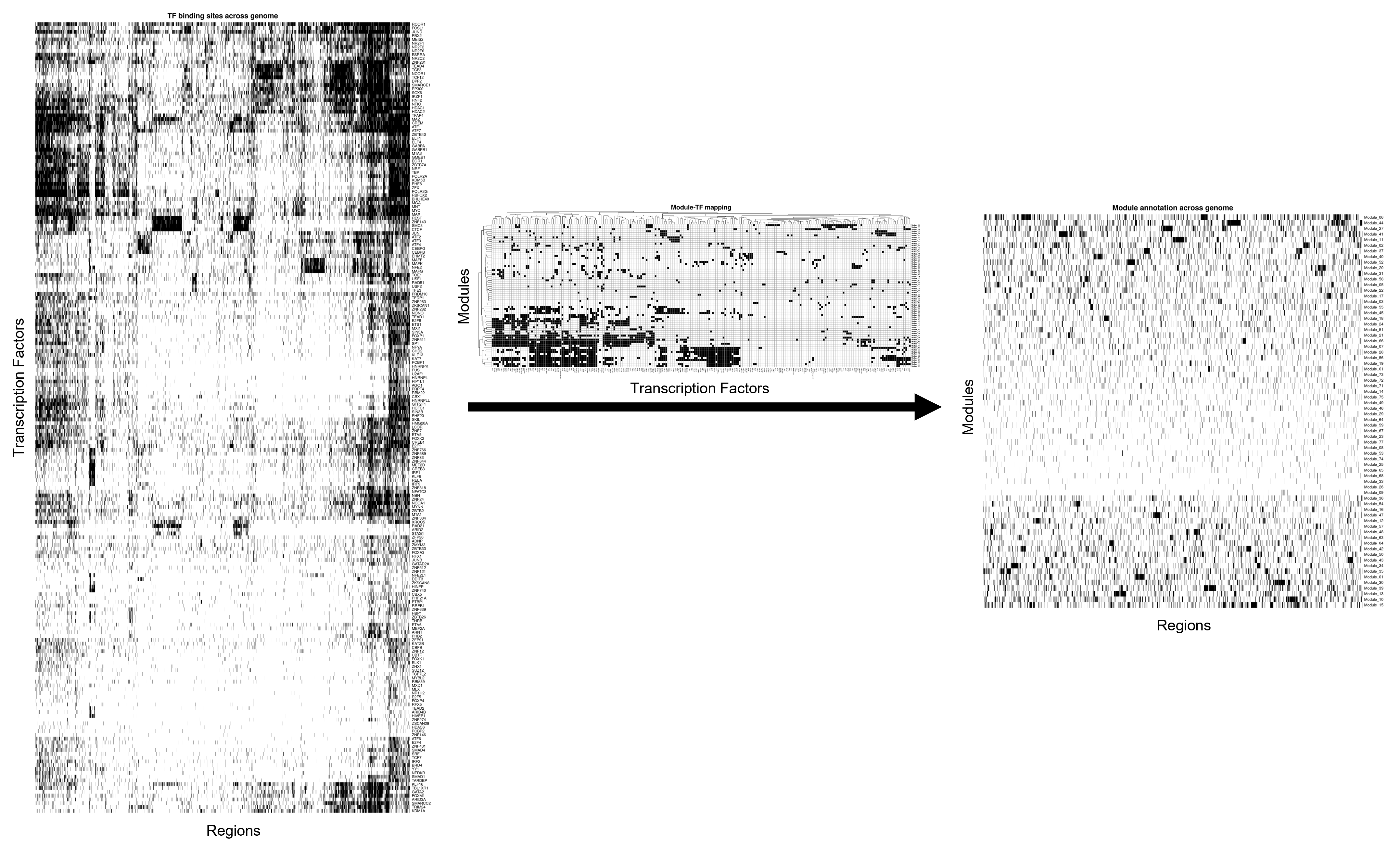
Apply topic modeling to group different TFs into modules and summarized the binding sites of each TF module.
The TF co-occupancy maps / colocalization
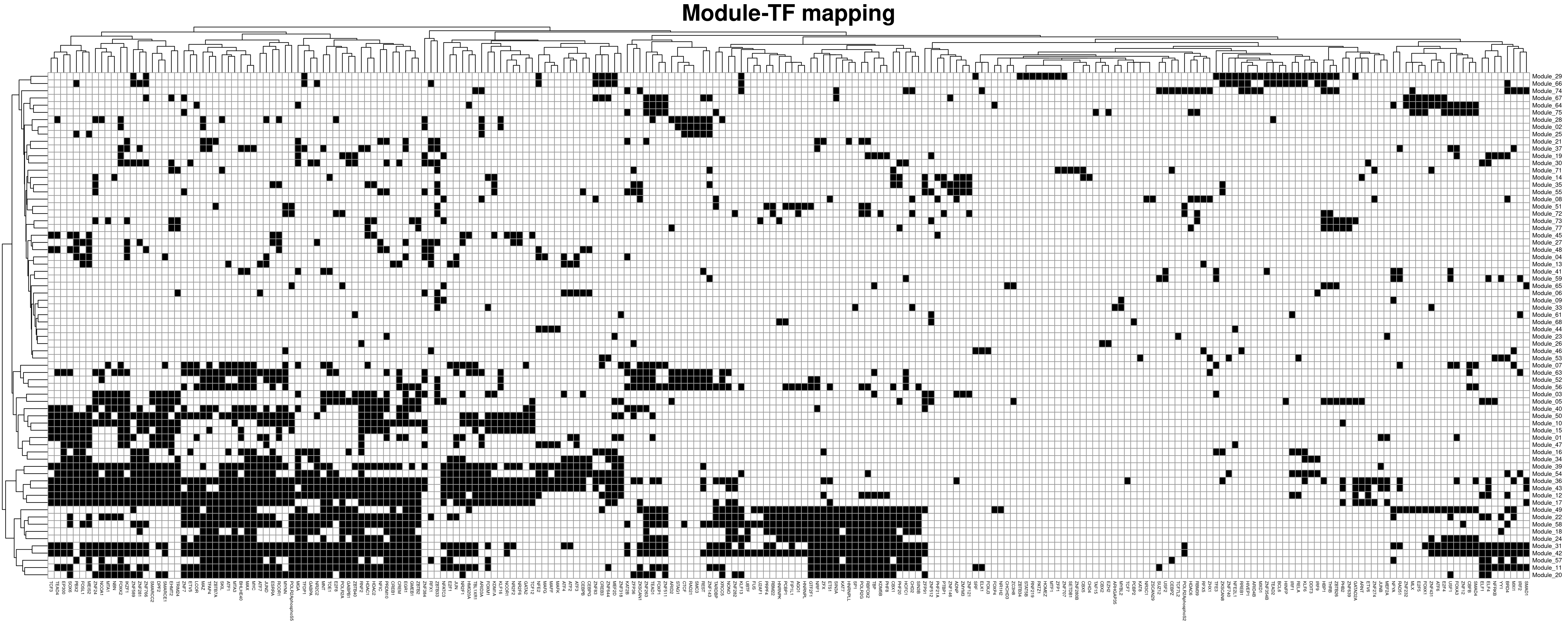
figure: TF co-binding matrix
- “K562.full.region.assignments.txt” has numbered columns referring to the Module numbers (1-77)
- Note that there are not 77 total modules because only modules with >500 regions were kept
- followed by “chr”, “start”, “end”, and “TF” columns which refer to the genomic positions and all TFs bound at that region
- “K562.TFzscore.txt” contains the TFs that passed our thresholds to be considered in the module.
- Note that a TF may be listed as bound to a module region in the above file, but if it did not pass the threshold it was not considered a module member.
- Details on our thresholds are below: a TF is kept in that module if it passed the following two conditions:
TF z-score > 0.- The
TF z-score= (# of regions bound by TF in the module of interest – mean(# of regions bound per module))/SD(# regions bound per module).
- The
module z-score > 0.- The
module z-score= (# of regions bound within module by TF of interest) – mean (# of regions bound by each TF within module))/SD(# regions bound per TF within module)
- The